









Why the Future of Work Is Still Human
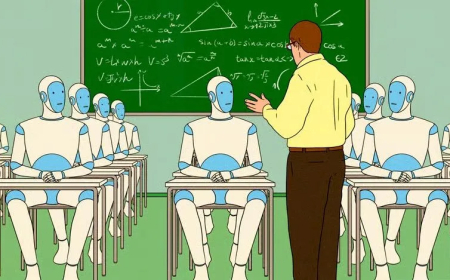
From training robots to supervising their behavior, new roles are emerging that keep humans firmly in charge of machines.

Recently, a fake job advertisement circulated widely on social media claiming that OpenAI, the maker of ChatGPT, was hiring an “emergency kill‑switch engineer.” According to the ad, the successful candidate would have to sit next to the servers all day and immediately cut the power “if the system rebels against us.” Among the listed “useful skills” was the ability to pour a bucket of water over the servers—purely as a precaution.
The human factor, watching over the machines
As The Economist writes, although fears about job destruction due to the spread of AI agents are widespread, the reality goes far beyond dark humor. The same technology is now creating demand for entirely new roles—from training AI agents to deploying them within organizations and monitoring their behavior. Crucially, many of these jobs rely above all on skills that are inherently human.
At the starting point are data labelers. This group is no longer made up solely of low‑paid gig workers monotonously tagging images. As AI advances, specialists in fields such as finance, law, and medicine are increasingly being employed to train models. The start‑up Mercor, which has built a platform for deploying top intellectual talent in robot development, was recently valued at 90 an hour.
Once training is complete, teams known as “forward‑deployed engineers,” or FDEs, take over—people responsible for embedding these systems inside organizations. Software company Palantir, considered a pioneer of this approach, presents a heroic image of the role. One commonly cited blog post by a former Palantir FDE begins like this: “At first it was just us—two engineers sent to a military base near Kandahar with minimal but clear instructions from Palo Alto: go there and win.”
In practice, these workers are a blend of programmer, consultant, and salesperson, operating on site at clients’ locations to tailor AI tools and bring them into production. Although the number of FDEs started from a small base, it is now growing rapidly. Garry Tan, head of start‑up incubator Y Combinator, recently said that companies in its portfolio are currently advertising 63 FDE positions, compared with just four last year.
As AI agents proliferate, their creators are forced to deeply understand the areas in which their products interact directly with people. For example, a company designing an AI customer‑service agent must understand why an angry customer might press “zero” simply to shout at a human being.
Himanshu Palsule, CEO of skills‑development company Cornerstone OnDemand, points to Waymo—the fast‑growing robotaxi company—to illustrate how programming jobs are changing. Waymo’s cars are autonomous from start to finish, but what happens if something goes wrong and passengers are locked inside? At that point, what he calls a “remote human supervisory workforce” steps in—people who not only understand the technology, but also know how to deal with distressed and angry passengers.
According to Palsule, software engineers were once valued primarily for their coding skills, not for communication or bedside manner. But those traits alone are no longer sufficient. Today, writing code can be delegated to an algorithm.
Next comes the growing importance of drafting rules and frameworks to ensure that AI agents do not create chaos. The AI Workforce Consortium, a research group led by Cisco, the networking‑equipment maker, recently examined 50 IT jobs in wealthy countries. It found that the fastest growth—outpacing even AI programmers—was in AI risk and governance specialists. These professionals are typically responsible for preventing data leaks, stopping bots from disrupting business operations, and performing similar tasks.
At the top of this complex coordination sits the chief AI officer, a role that is steadily gaining popularity among corporate executives. These leaders typically combine technical expertise with deep knowledge of a specific industry and experience in organizational transformation. Still, the job is far from easy. According to IBM, a typical large company uses an average of around 11 generative AI models and is constantly under pressure from vendors offering AI agents for every conceivable function. In such circumstances, those in charge may be the first to feel the urge to reach for that very “emergency kill switch.”